
Fundraising in the Age of AI: What LPs Are Expecting Now
Artificial intelligence is reshaping how limited partners (LPs) evaluate fund managers, and the bar for general partners (GP) is rising. In a fundraising environment marked by extended fund cycles, heightened selectivity and growing LP sophistication, understanding what investors are looking for has never been more critical.
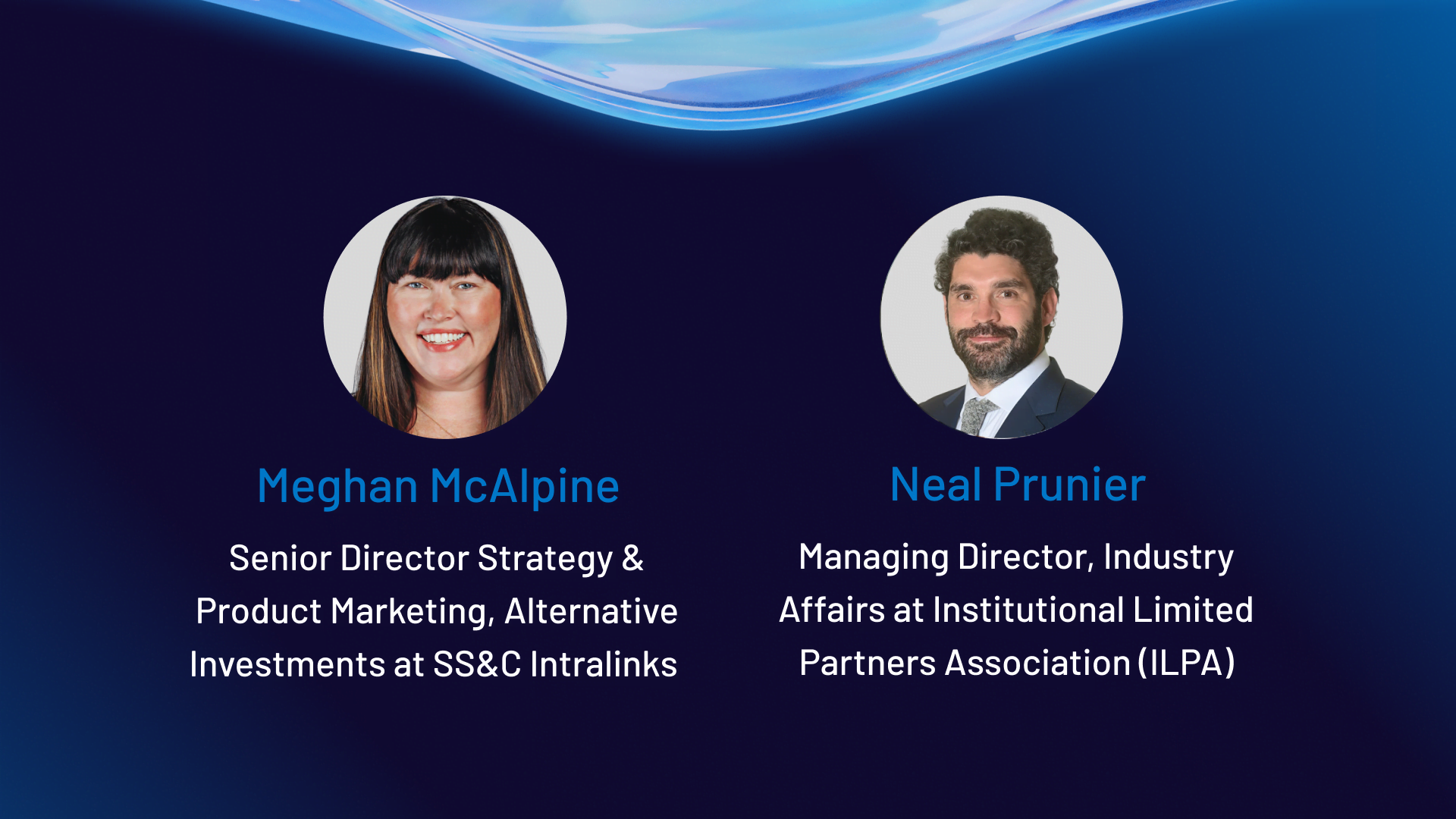
Join us for a fireside chat with Neal Prunier, managing director of industry affairs at ILPA, as we explore how AI is changing the LP due diligence process and what GPs need to know heading into the second half of 2026.
The session will explore:
- The fundraising outlook for H2 2026
- How LPs are evaluating managers in a more selective market
- AI’s growing influence on due diligence and fund management operations
- Upcoming ILPA initiatives for the year ahead
Speaker:
- Neal Prunier, Managing Director, Industry Affairs, Institutional Limited Partners Association (ILPA)
Moderator:
- Meghan McAlpine, Senior Director, Strategy & Product Marketing, SS&C Intralinks
Running time:
- 45 minutes
Transcript
Meghan McAlpine
00:04 - 01:18
Hi, everyone. Thank you so much for joining us for today for our fireside chat.
We're gonna be discussing fundraising in the age of AI, what LPs are expecting now. I'm Megan McAlpine.
I'm the senior director of strategy and product marketing at SS and C Intralinks. For those of you that don't know SS and C Intralinks, our technology and services help fund managers across their entire fund life cycle from marketing and fundraising to investor onboarding, deal management, fund reporting, all the way through to investor communications.
More than $1 of every $2 raised globally was done on our platform for private capital. And we're also supported by SSS and C, who is our parent company, and they are the largest fund administrator.
I'm excited to be joined by Neil Pournier from ILPA. Before we dive into our discussion, I have two housekeeping housekeeping items for you guys.
First, today's event will be recorded, and we'll be sending out a recording of that following the session. And then secondly, we'd love to hear from you questions.
You'll see a q and a module on your screen. Please feel free to add any questions there, and we'll leave some time at the end for those as well.
Without further ado, I'll turn it over to Neil to introduce himself before we get into the discussion.
Neal Prunier
01:18 - 01:51
Hi, Megan. Thanks so much for having me.
It's always a a pleasure being part of the the webinars hosted by SS and C, Intralinks. My name is Neil Pournier, managing director of industry affairs at ILPA.
The way I like to describe that is I lead our efforts across both our bottoms up standards and best practices as well as our top down legal, regulatory, and and policy work. FILPA as an organization represents LPs around the globe with over 650 members representing over 3,000,000,000,000 in assets invested into private markets.
Meghan McAlpine
01:51 - 02:24
Great. Thanks so much, Neil.
Alright. So I'd love to start with kind of the fundraising market today, what we're seeing outlook.
So, you know, first half of twenty twenty six, we're we're through. Fundraising environment has definitely been a bit challenging for many managers.
We're definitely seeing less capital being raised across fewer funds, and the average size of fund has shrunk as well. From ILPA's vantage point, Neil, what are you hearing from your LP members about their deployment pace and their appetite heading into h two?
Neal Prunier
02:24 - 04:04
Sure. And I know this is top of mind for a lot of GPs and and top of mind for a lot of LPs as they think about their own pace of fundraising and and pace of investments.
If we take a quick step back and look at how LPs are viewing their program holistically, in some recent surveying and and pulling that we've done of our members, almost 90% of them have identified that their allocations to PE are either at target or within range, and that average target is coming in allocation coming in at roughly 17%. And so as LPs look ahead to the next five years, 52 expect that portfolio allocation to PE to stay roughly the same, and 38% are expecting it to increase.
And as we think about the next twelve months in particular, 72% of LPs indicated that they will adjust their PE program with a much greater preference for increasing rather than decreasing. So for example, 18% of LPs indicated that they anticipate increasing managers that they're investing in versus 5% that are planning to decrease.
15%, are planning to increase both commitment and managers, and 11% are planning to increase commitments. So it is very important for LPs as they think about vintage year diversification and their pacing to have consistent pacing into the market, and they don't wanna take a year off, for example.
So we do anticipate that the back half, will be active for LPs as they look to deploy their capital, especially those that are either staying at their 17% target allocation or are looking to increase that.
Meghan McAlpine
04:04 - 04:44
So overall, fairly good news, which I think is good. In terms of kind of fundraising cycles, we're definitely seeing extended fundraising timelines.
It's definitely become a bit of the norm for a lot of GPs. I think it is interesting though our most recent global private capital fundraising report actually shows that the average time to close has gone down.
So it's actually at a decade it's a decade low of fourteen point six months right now, I think, which is promising. But, Neil, love to get your thoughts on how LPs are thinking about reop decisions when especially when their existing managers might still be in the market or taking a little bit longer to kinda close out their funds.
Neal Prunier
04:44 - 06:51
Yeah. And and so I think one thing I wanna try to do throughout my time here today is is share some of the the LP perspective and and what you might not be aware of as GPs or or other service providers and and participants in the industry.
So completely recognize that it is top of mind for GPs, the extended fund cycles, and and that has become more normal for many GPs. For many LPs right now, they are experiencing increased scrutiny, becoming more normal, and having more difficult conversations internally with stakeholders, especially as you think about the one year and three year and even now five year performance being behind the the benchmark.
As I identified in my first response, LPs are planning, if anything, to stay the same or increase their allocation to PE. So the benefits of PE are still clearly recognized by LPs and their investment committees, their boards, but the the conversations have become more difficult due to the the performance.
That much being said, they are being even more mindful about who they are re upping with. So when we've pulled and asked our members about what is your top criteria when thinking about bringing a a fund to the investment criteria.
The top two are long term track record and repeatable alpha model. So this is really oriented around performance and being able to drive performance through different cycles and consistently drive performance.
When we've asked our members about what their top areas of focus are, what they're thinking about day in and day out, it's typically exit environment and liquidity mechanisms. So performance is the the top factor, And generating real exits rather than an overreliance on CVs, those are really important components to LPs today as is coinvestment access.
And as they think about this, it does lead them at times to be more focused on their core portfolio and those that have been generating historically and currently strong performance in the market.
Meghan McAlpine
06:51 - 07:24
Makes sense. And we'll get to CVs, I think, a little bit later, but, makes a lot of sense.
You obviously said PE is a big part of, you know, LP's portfolio. We're seeing that as well.
Venture as well has been a large part of fundraising, the market this year so far. We're also seeing a lot of interest in infrastructure, secondary funds.
But I'd love to get your your viewpoint. You know, are there specific fund types or strategies that you're seeing that really LPs remain most active with, or are there any that they're kind of cautious about right now?
Neal Prunier
07:24 - 08:38
Sure. So a a few trends in mind.
One, over 75% of our members, indicated that they expect to increase their exposure to the mid market, namely to get access to some of the specialization and some of the ability to to generate alpha. Nearly half of our members expect to decrease their exposure to the large cap.
Some frustrations and concerns about asset gathering at that stage and more likely to be involved in retail capital which is a point of conflict between LPs and GPs. As we think about particular sectors of interest, you mentioned infrastructure.
That's top amongst them. So is health care, industrials, financial services, and defense.
There's been a lot of talk about AI and and software. That is something that remains an interesting investment, but something that LPs are really actively working to get a a better sense of, how it's performing today.
Things are changing rapidly, especially with AI and and software, And so LPs wanna make sure that they, are comfortable with all their existing investments and the the new investments that they wanna put in the ground.
Meghan McAlpine
08:38 - 09:00
Makes sense. I'd like to turn to kind of LP evaluation, manager selectivity.
We're obviously seeing that LPs are just a lot more selective in the current environment. And I'd love to hear how you know, what characteristics you think are separating the managers that are getting the allocations, from LPs versus the ones that are struggling a bit to get those allocations.
Neal Prunier
09:00 - 11:27
Sure. So I mentioned before the the top two items within the considerations to bring a fund to the investment committee, those being long term track record and repeatable alpha model.
To round out the top five. The the three, four, and five are alignment of interests, talent model, and reporting and transparency.
And hopefully these don't come as a surprise, but these are our core elements that LPs look for and are characteristics that can help GPs separate themselves. As we think about alignment of interest, this has to do with things like GP commitments and co investment access.
Talent model, I think, speaks a lot to succession planning, the incentive structure, and how is the organization ensuring it's being run-in such a way that promote that long term track record three, five, ten years into the future. And then reporting and transparency, and that has historically been a a major focus for ILPA here, and it is a major consideration for LPs as they're thinking about investment decisions, being able to get access to the information that they need on a quarterly and and annual basis, as well as then just generally good communication and good transparency between the GP and the LP.
One item I do wanna highlight, I know DPI is very top of mind right now. Distribution profile does not make that top five considerations of a fund being brought to the investment committee.
So I I do wanna call that out and wanna caution against chasing DPI for GPs, especially at the cost of longer term returns. As we've polled our members, 59% have indicated that they have a long term return preference compared to a quarter that have a near term liquidity preference.
Part of the challenge here for GPs though is, you know, that's not a 100% to zero. LPs are are not a monolith.
We recognize that. LPs recognize that.
And that is why it's so important to have that good reporting and transparency, that good alignment of interest with LPs to have those conversations and to understand what is important to your LPs holistically and individually during this investment cycle.
Meghan McAlpine
11:27 - 11:53
Yeah. I think on top of that, I'd love to hear more about kind of relationships.
We're hearing relationships are matter more than ever in this environment, particularly when, you know, it's longer fundraising timelines, longer time to exit investments. So that relationship is being built up.
Is that what you're hearing from LPs, or are they really just still prioritizing performance? I mean, you've named five five different things that they're looking at, but where does kind of relationships fall within that as well?
Neal Prunier
11:53 - 13:42
So I think realistically, performance is always gonna be a key factor. And and I don't wanna diminish the importance of relationships, but I think it can be tough to stand up in front of your investment committee and continue to push for a bottom decile performing fund because the relationship is strong.
So performance is always going to be an important mechanic here. That being said, relationships are absolutely critical as you think about the re up decisions and the ongoing engagement throughout the the fund life cycle.
There's a lot of difficult, environments right now as it relates to funds that are challenging to fundraise or have, underlying portfolio investments that are older and older and facing some difficult decisions. And so it is really important to have good relationships in place with LPs to sort through these different, challenges and and to have that built in trust and faith in that partnership between limited partners and general partners.
You know, making a decision to invest in a new fund, historically, it talked about it as a a ten year relationship. Now increasingly, it is a a fifteen year relationship.
And as you think about then re upping in the the next fund, that becomes that much longer as well. So, performance is always going to be top of mind, but relationships are really important and a central element for GPs to focus on.
And this can be done, again, through the transparency, through how there is engagement with the LPAC, how there's engagement with the wider LP base holistically and and during AGMs, to make sure that, you know, that foundational trust is there, between the different parties.
Meghan McAlpine
13:42 - 13:55
Yeah. I hear you.
I think, you know, someone in the bottom decile, they're not gonna their relationship is not gonna move the needle, but I think it does give managers a leg up if they're kinda neck and neck with someone else kind of during that the fundraising process. So definitely something to keep in mind.
Neal Prunier
13:55 - 13:57
Right.
Meghan McAlpine
13:57 - 14:23
Great. Okay.
So love to switch now to the topic of the day, AI and technology. So we are hearing about AI everywhere.
People are having conversations all over the place. Would love to hear from you kind of, from ILPA members where are LPs actually using AI in their diligence process today versus, you know, what is a little bit more aspirational or where they wanna get to eventually?
Neal Prunier
14:23 - 16:56
Sure. So if we look at it from a a macro standpoint, and this is from our recent members conference just earlier in June, we pulled the attendees, and over 60% of LPs at the conference were using AI holistically.
It's not just focused on due diligence. And this was up from 31% who were asked the same question last year.
So roughly a 100% increase in one year, which is great to see. And if you look at other industries, you know, 60% is well above what you're seeing in financial services, for example, or or other, tech oriented industries.
If you talk to LPs and for some reason there's always a a baseball analogy, they will describe it as early innings. So in their second or third inning, where they've started to use it, everybody at least has Copilot if they're Microsoft users or or some have a few different, programs or or even some specialty applications that they have access to.
As we've been talking to LPs about it, something that's come up is just the the model of read, write, own, with read being where AI surfaces and retrieves and summarizes information, write being where AI creates the first draft of work product, and own being where AI is actually owning more of the workflow. As we've been talking to LPs, many more are in that read category where they're using AI to pull information.
So if we think about due diligence, to pull information from DDQs, to pull information from the data or more broadly to help with some additional analysis, to help with some additional comparison. Not fully at the stage of right.
I know what a number of LPs are excited about is the opportunity to to use AI to to do a first draft of an IC memo, and some of their recommendations or or some of their other analysis. Some have started to experiment with that, but it's much more at that read stage and building out the comfort, making that step up to write.
I know some LPs have built their own agents for different responsibilities, but I think you would see few who are fully viewing AI as falling into the own category today, within their internal workflows.
Meghan McAlpine
16:56 - 17:26
Love that analogy. And I think on the GP side, we're seeing the same thing where, you know, some GPs and fund managers are heavily investing in AI, and they're, you know, very sophisticated at this point.
But I think there are a lot of GPs kind of on the other end that, you know, a lot of people are using it for personal use, and that's kind of bringing it up a bit in their organization. But I think the broad, you know, use of AI is still kind of an early days for a lot of GPs too.
And so I think, it's helpful for them to kind of understand best practices and things like that.
Neal Prunier
17:26 - 17:26
Right.
Meghan McAlpine
17:26 - 17:55
In terms of GPs, we are seeing a lot of them using AI, to streamline the DDQ process. I think that is very helpful and, obviously, in some reporting workflows.
Do you see are LPs seeing the benefit of that yet? And then additionally, kind of second second part of that question is, are they expecting an investment in AI from their GPs, particularly when they are evaluating a manager during fundraising? Is that something that's kinda top of mind for them when they're looking at a fund manager?
Neal Prunier
17:55 - 20:23
Yep. And I think it's a great question.
One one quick note here. There has been some increasing frustration amongst LPs and and just conversations related to passing the cost of AI onto LPs, and that being viewed as a pain point versus being covered by the management fee.
That's why transparency into fees and expenses is so important as is how this is actually getting captured and is it being thought of as something that's needed to keep the lights on and something that's shared across all funds from a management fee standpoint, or is it getting passed on as a partnership expense, especially as AI gets used more and more heavily? But holistically, I think LPs are very interested in how their GPs are making use of AI internally, especially as it relates to being able to make information more readily available to LPs, being able to provide it more quickly or go more in-depth or ideally both, when we think about due diligence or even quarterly and annual reporting. Something that has really started to stand out is how important it is for standardization to truly unlock the power of AI.
And not standardization, perhaps how we thought about it in the past, if you think about some of Hilda's previous templates of making sure the same data point is in cell b 17 quarter over quarter, but more so getting the same responses for the same line items or for the same question sets. Now that you can store some of this information more systematically for LPs, it is that much more useful and meaningful to have data provided in standardized formats to then allow even more in-depth comparison and analysis to take place across funds, across GPs, across sectors, vintages, whatnot.
And that takes having access to apples to apples data. So it is an important consideration to LPs.
They wanna be able to see how their GPs are are innovating and ideally using it as a way to get better information over to LPs. But then there is that point I referenced at the top about how are costs associated with AI being treated at the fund level.
Meghan McAlpine
20:23 - 20:56
Use the AI. Just don't charge us for the AI.
That's what you're saying. One other concern that we're hearing obviously from both GPs and LPs is around is around data integrity, especially when AI is involved in, you know, creating the due diligence materials.
At SSNC Interlinks, we obviously take data privacy very seriously. We actually make sure that our models are not trained on client data.
But in terms of data integrity, does ILPA have any guidance around those topics?
Neal Prunier
20:56 - 23:00
Sure. So when we think about LPs, and I mentioned our members conference in June, they identified that their biggest concern about AI today and their own use is misinformation or errors being introduced as a result of using AI.
And something that was an important part of that conversation was that there always and and needs to be that human element of the review. So whether you're a investment team member on the LP side or the GP side, ultimate accountability lands on you for the final work product.
And if you're using AI, there should still then be a review of anything getting sent out to ensure the accuracy, to ensure that it meets all the various compliance standards and and everything else that it needs, much like if it was being done on a manual basis. And and that's something that LPs, to your previous question, wanna make sure that GPs have good systems in place as you think about people process and technology for how they're implementing AI.
I know amongst LPs, and this is true beyond just the the investment landscape, you know, how are you training up younger staff to make sure that the knowledge development is still taking place and that AI isn't being used as a shortcut that might help a task in at hand get completed more quickly, but in the long term have a negative impact on one's learning and and development from a knowledge standpoint and a true understanding standpoint. And that's important as well within the GP organization as they think about the the controls in place, and how AI is getting implemented to ensure the benefits are being recognized while taking active steps to try to minimize some of the potential cons as it comes to talent development, which is very important to LPs, but also data integrity and any data security risks that may come up.
Meghan McAlpine
23:00 - 23:41
Yeah. For sure.
I think from our point of view too, any kind of vendor technology that the GP is using, just making sure that that that vendor has security data privacy in place as well. I think that's definitely beneficial.
Moving to, Elpa, you just put out the most recent update of your DDQ, significant update. As GPs are starting to use these AI tools to help populate responses for DDQs.
Do you see the need to evolve the DDQ framework further to kind of account for how this content is being generated? Is that kind of in your plans, or what what do you think about that?
Neal Prunier
23:41 - 26:07
Yeah. And that's a a great question.
And it is it feels like just yesterday, but we're going on about five years since the DDQ two point o was updated. And I remember talking to you in early days of that project, Megan.
It it it does seem like just yesterday. So this is something that we are considering as a project to pick up in full next year as we think about a refresh.
Just how much has changed over the last five years that needs to be incorporated into a DDQ that comes out in 2027 versus one that that comes out in 2021. And one of the things that we want to make sure we're doing as part of that work is keeping in mind what the current technological infrastructure is.
AI was not really something that was being used in 2021, and we were focused on due diligence engines and other tools of that as far as some of the the cutting edge technology, which is still really making an impact in the industry. But as a AI becomes more of a reality and and more of a central piece, we wanna make sure that our work is being done in such a way that supports that and is enhanced by the use of AI to allow for a more seamless production by GPs and to allow for a better end product to meet LPs.
As mentioned, one of the biggest challenges with due diligence historically has been that it's just stored data. And sometimes in the past, it was just stored in a word document or a PDF.
And now being able to put it in systems more actively, being able to use it and compare responses across GPs, across funds, across sectors, to do even more analysis, to do even more comparisons is really exciting. And we wanna make sure as part of any update, we understand what would be really important from service providers like yourselves or or from GPs to really tap into the benefits and possibilities of AI.
We as ILPA recognize that we're not always, you know, the cutting edge, bleeding edge from a technology standpoint, but wanna make sure that the only way to get the information isn't via a word document or via a.
Meghan McAlpine
26:07 - 26:14
Yeah. A lot more consistency kind of with the tools that are out there now, which is great.
And 2021 does feel like yesterday.
Neal Prunier
26:14 - 26:15
PDF.
Meghan McAlpine
26:15 - 26:44
It's crazy that that's five years ago. Just wanna remind the audience, if you do have any questions, please feel free to put that up in that q and a box, and we will save some time at the end to get to those as well.
Next, I wanna turn to just some ILPA initiatives that are upcoming. So love to hear from you what are the top priorities that ILPA is focused on, you know, for the rest of 2026.
Obviously, you just mentioned DDQ for next year, but anything else, that GP should really have on their radar?
Neal Prunier
26:44 - 31:39
Sure. So, a few items that I'll touch on here first, and it it came up a bit in my earlier responses, but continuation vehicles, those remain a key item for ILPA and our members, especially as you think about the data varies, but anywhere between 10 to 1520% of exits coming via CVs in 2025, They are a tool that we and our members recognize are are here to stay.
We had come out in 2023 with guidance on continuation vehicles. And then earlier this year, we came out with a disclosure template designed to help improve the transparency and decision making process for LPs during the the role sell decision.
We did actually just a couple weeks ago, go out for a public comment period which you can access via the ILPA website for updated CV guidance. And so it has only been a a few years less than our last DDQ update since we put out materials on CVs.
But because of the widespread use of it, realistically, because of some of the frustration amongst LPs with what is thought of at times as misuse, especially based off of limited transparency or limited commercial rationale for why the CV is the preferred outcome relative to other liquidity options or relative to other, options for exits. We felt that it was very necessary to come out with updated guidance.
We'll be running the comment period through early August. We have a webcast, for later in July on the twenty second on the ILPA platform, to talk further about the work and give everybody more insight in advance of the comment period ending.
And we anticipate having this rolled out, some point in the fall, by October, and give everybody a chance to to digest that. But this is something that we, have been placing a lot of priority on, because of the increased use of it across the industry.
One of the other projects that will be coming out for comment period here later in July, it's been a very active year for ILPA, we've been working on an update to one of our latest templates, the portfolio company template. So this has been a project much like some of our recent template updates that we've run where we've engaged with LPs, GPs, and series of service providers with a working group, a steering committee, and our broader satellite group.
This common period, as mentioned, will be starting towards the end of July with the idea of, running it over the course of the summer into early fall and having this template finalized and released out in January 2027. We don't anticipate the implementation or needed adoption for it to be until 2028.
Partly because just earlier this year, post one q, we had our reporting template be provided out by GPs for the first time in the updated version relative to the 2,016 version. And next year, we'll have our performance template and capital call and distribution template go into effect as well.
So we're trying to be more programmatic with how we update our various templates. We do recognize that it's a lot of work for GPs and service providers, especially those incredible fund administrators, to build out the technology to support this.
And so we wanna be able to broadcast that more, make sure we're not going ten years between updates but also, don't necessarily wanna update it every year or two given that the work that goes into, implementation within a GP and fund administrator organization. The other item I'd referenced that is top of mind for us and continues to be a point of focus, and I mentioned it a little bit as it related to some of the reason that LPs are drawing back from certain large cap managers.
But it's just evergreen capital, retail capital, and implications that has for the broader private markets as well as particular implications that that has for institutional investors, given some of the dynamics in the institutional funds versus the retail funds, with the dynamics between the institutional investors and the retail investors, investing in the same underlying portfolio investments despite at times very different performance expectations, liquidity needs, risk tolerances, and just understanding of the dynamics of the investments themselves.
Meghan McAlpine
31:39 - 31:43
Sounds like you'll be very busy the rest of this year and the next year, I think.
Neal Prunier
31:43 - 32:35
Yeah. There's never never a dull moment.
It's been, you know, tremendous, I think, a tremendous time to to help try to provide greater insight and perspective for the industry. And something that we as ILPA really do care deeply about is the health of the industry.
Our core tenants are built around trying to enhance transparency, governance, and alignment of interest, and and hopefully that's seen through all the work that we come out with. And really do wanna encourage as much engagement as possible with our various comment periods.
The more that we hear from the industry, the more that we can make sure that what we come out with, whether it is our fee and expense reporting template or CV guidance or in the future, our DDQ to make sure it's as relevant and is and impactful as possible for the broader industry.
Meghan McAlpine
32:35 - 32:42
Yeah. Especially the the CV guidance.
I mean, given we're seeing, obviously, the s e SEC is kind of upping their focus and.
Neal Prunier
32:42 - 32:42
Alright.
Meghan McAlpine
32:42 - 33:05
potential enforcement on, CVs. I think that makes a lot of sense right now, in the current market.
Is there anything in the industry that that you think the industry is maybe underestimating or not paying attention to enough attention to that ILPA is is watching closely? Or, I mean, I know you kinda walked through a lot of things, but is there anything else that you're seeing?
Neal Prunier
33:05 - 34:25
I think the other topic that I didn't mention that is top of mind for us right now is valuations, and how are valuations playing out today, and how does that relate to prices at exit? And is there a need to reset some of the the latest marks and come down, to have a stronger connection than with the price at market rather than having a decrease relative to the previous mark when you think about the the exit price. Holistically then, much like some of the earlier questions, I think top of mind for us and top of mind for a lot of our members, it's just the general exit environment.
I know there was a lot of optimism heading in to the beginning of twenty twenty five, and then we had all the tariffs. There's a lot of optimism then coming in at the beginning of twenty twenty six, and we had the the war breakout, and some other developments that have just caused the the slowdown and other macroeconomic challenges.
So it's top of mind for us, top of mind for our members, what the back half of the year looks like as far as exits, whether it's, m and a, whether it's IPO, actively monitoring that space.
Meghan McAlpine
34:25 - 34:58
Great. Well, those are the questions I had.
I do wanna mention again to the audience, if you have any questions for Neil, please add them into that q and a box, and we can answer those. I think one additional thing while we wait for some questions to come in.
If you could give kind of one piece of advice to a GP heading into the fund a fundraiser in this environment, what would that be? Or maybe a couple pieces of advice. What would be the biggest thing that you would give to somebody going into the environment at this point?
Neal Prunier
34:58 - 35:53
Sure. I think it some of the points that I'd highlighted before, but it it goes back to the the transparency.
It goes back to the relationships and making sure, especially as you are fundraising, LPs are mindful of what do valuations look like during fundraising, or is there a push to get distributions back during fundraising to provide money to support that next commitment. And so LPs wanna see consistent behavior throughout and and wanna see that good strong communication and transparency throughout the life cycle, and be closely connected to your LPs about what your plans are for the next fund, what your intentions are, and making sure that all the necessary information is getting provided, so that LPs can get comfortable with their due diligence and with their underwriting process.
Meghan McAlpine
35:53 - 36:36
Great. And I just wanted to mention everyone.
We're gonna put up a ticker here. So we just as I mentioned earlier, we put out a global private capital fundraising report, this last month, I guess, now in June.
And if you click there, you'll be able to download that just to get some more insights on the fundraising environment, and there's some information about AI in there as well, which I think is really helpful. So feel free to click on that ticker right below us, and you can get that information.
Okay. So, one of the questions that just came in, are there any geographies that LPs are favoring today? I know from our perspective, North America seems to be leading the the path, but we'd love to hear, what you think there, Neil.
Neal Prunier
36:36 - 37:02
Yeah. And that's a great question.
I think we are expecting to see some reduction in North America, but that hasn't come through in our conversations and our polling with our members is that North America remains one of the, leading investment pipelines, for global LPs. Have seen some uptick in Europe, but haven't seen a big drop off from North America.
Meghan McAlpine
37:02 - 37:10
Alright. Next question.
Emerging managers, how are they faring with LPs? Any, insights there?
Neal Prunier
37:10 - 38:25
Sure. And that's a great question.
I I mentioned before some of the stats related to mid market and large cap, again indicate that, 31% of members anticipated increasing exposure to emerging managers. That does come with, though, 15% who indicated a decrease.
So net is 16% with emerging managers themselves. It is something that a lot of LPs see the benefit in and see the value in in terms of cert, supporting a GP early on in the development of their franchise, and being able to see, some of the outperformance that has been a result of emerging managers in the past.
So that that is something that LPs are continuously interested in. I know at our various matchmaking events, we always have designated emerging manager slots because how much we wanna make sure we're facilitating engagement and interaction between, emerging managers and LPs because it remains a, a point of emphasis for, the LP community.
Meghan McAlpine
38:25 - 38:35
Great. And, looks like one of the last ones here.
You said fundraising expects to increase in h two. What do you see for 2027?
Neal Prunier
38:35 - 39:24
Sure. So I think we would expect given some of the data about allocation targets, that 2027 is, if anything, going to be similar to 2025 or increased.
I don't see any significant slippage there. Again, our our members continue to feel positively despite some of the headwinds that private markets are facing right now.
So would anticipate, an active fundraising environment in the second half and in 2027. There is not a significant drawback in in mind, from LPs where they're planning on significantly shifting their targets or or shifting their approach.
Any shift is typically going to be on the the increased size.
Meghan McAlpine
39:24 - 39:27
Good news. I think it's a good way to end end this.
Neal Prunier
39:27 - 39:30
think. that's hopefully, yes, a a great way to end it.
Meghan McAlpine
39:30 - 39:49
But just one last question. Someone asked if there's a replay available at the event.
There will be. We've recorded this, and we will send that out to to everyone that attends that wasn't able to attend.
But I'd like to thank Neil for your insights. I think it was really helpful.
A lot of positive insights, which I think is great. Thank you so much all for listening.
Thank you.
Neal Prunier
39:49 - 39:50
Thanks so much.